



Who Invented Glasses and How They Changed the World
Nobody holds a patent on glasses.
The invention of glasses does not belong to a single person and a single moment. It was a slow convergence of Islamic science Italian glasswork and monastic need that produced the first wearable spectacles somewhere in Northern Italy between 1268 and 1300. What followed changed the course of literacy scholarship and eventually fashion. The same optical principles that kept medieval monks reading into old age now sit inside the precision-built frames at Bling Optical — 700 years of refinement in every hinge and lens.
|
Quick Reference — History of Glasses |
|
First wearable spectacles — Northern Italy c.1268–1300 |
|
Scientific foundation — Ibn al-Haytham Book of Optics 1011 AD |
|
Temple arms (ear pieces) — Edward Scarlett London 1727 |
|
Bifocals — Benjamin Franklin 1784 |
|
Mass sunglasses — Sam Foster Atlantic City 1929 |
|
Progressive lenses — first introduced 1959 |
Early Origins of Glasses

The path to wearable spectacles started with people holding things up to their eyes and squinting.
Ancient Magnifiers and the Reading Stone
Long before anyone ground a corrective lens the Romans were experimenting with curved glass. Around 60 AD the philosopher Seneca reportedly used a water-filled glass globe to magnify text. Nero is said to have watched gladiator fights through a polished emerald — an early if accidental experiment with tinted viewing.
The more practical development came around 1000 AD with the reading stone. These were semi-spherical lenses ground from polished quartz beryl or glass. A monk would set one directly on a manuscript and lean in to read the enlarged script underneath. No frame. No bridge. Just optics working as simple magnification for farsighted presbyopic readers.
The Islamic Golden Age and the Science of Optics

The reading stone worked by accident of geometry. The science explaining why it worked came from the Islamic world.
Ibn al-Haytham — known in the West as Alhazen — published his Book of Optics around 1011 AD. Before this text the prevailing theory was that the eye emitted rays that reached out to touch objects. Ibn al-Haytham proved the opposite. Light reflects off objects and travels into the eye. This reversal was not a small correction. It was the entire foundation on which corrective lens design would eventually be built.
His geometric descriptions of how curved surfaces bend and concentrate light were the instruction manual that European monks and glassmakers needed when the text was translated into Latin in 1240. Without Ibn al-Haytham there are no spectacles.
The Birth of Wearable Spectacles

Italian glassmakers — particularly those in the workshops of Venice and Pisa — combined Islamic optical theory with their own expertise in fine glass production. The result was the first pair of rivet spectacles.
These were not comfortable frames. Two convex lenses were set in leather or bone mounts and joined at the handles by a single metal rivet. The wearer balanced them on the bridge of the nose or held them up by hand. There were no ear pieces. No temples. No adjustable fit. But they worked. And they allowed monks scholars and skilled craftsmen to continue reading and fine work years beyond what unassisted aging vision would permit.
The earliest visual evidence is a 1352 portrait by Tommaso da Modena showing a cardinal using rivet spectacles while reading. The tool existed. The demand was real.
Key Figures in the Invention of Eyeglasses

Alhazen and the Foundations of Optics
Ibn al-Haytham's contribution was purely scientific. He did not build a pair of glasses. He proved the physics that made glasses possible.
His Book of Optics described for the first time how a convex lens could focus light and magnify an image. When this text reached European universities in the 13th century it gave glassmakers the theoretical basis for grinding lenses to specific shapes for specific visual effects. The science preceded the product by roughly two centuries.
Roger Bacon and the Science Behind Lenses

In 1267 the English friar Roger Bacon wrote in his Opus Majus that transparent bodies shaped in a particular way could help the elderly and those with weak eyes see letters more clearly. He was describing convex lenses as a medical tool.
Bacon did not build these lenses himself. But he was the first European writer to articulate the medical application of curved glass as vision correction. He bridged the gap between Ibn al-Haytham's physics and the practical needs of aging readers.
Salvino D'Armati — The Famous Hoax
If you search for who invented glasses the name Salvino D'Armati often appears alongside a date of 1284. Modern historians have established that this is a 17th-century fabrication.
A Florentine writer in 1684 claimed to have found a tombstone crediting D'Armati as the inventor of spectacles. No records of this person exist from the 13th century. The likely explanation is that the actual inventor was an anonymous artisan who kept their technique secret to protect a profitable trade. Italy in the 1290s had no patent system. The best protection for a craft innovation was silence.
Timeline of Eyeglasses Invention
|
Year / Era |
Milestone |
Significance |
|
~60 AD |
The water globe |
Roman philosopher Seneca reportedly used a water-filled glass sphere to enlarge text |
|
~1000 AD |
Reading stones |
Monks used polished quartz domes placed on manuscripts to aid farsighted reading |
|
1011 |
Book of Optics published |
Ibn al-Haytham proved light travels to the eye — the scientific foundation of lenses |
|
1268–1300 |
First wearable spectacles |
Rivet spectacles invented in Northern Italy — two lenses joined by a pin at the bridge |
|
1440s |
Gutenberg printing press |
Mass literacy created mass demand for reading glasses across Europe |
|
1600s |
Concave lenses introduced |
Nearsightedness could finally be corrected — not just farsightedness |
|
1727 |
Temple arms invented |
London optician Edward Scarlett added ear-resting arms — hands-free wear begins |
|
1784 |
Benjamin Franklin bifocals |
Two prescription zones in one frame — near and distance vision combined |
|
1825 |
Astigmatism correction |
Sir George Airy invented cylindrical lenses for irregular eye shapes |
|
1929 |
Mass-produced sunglasses |
Sam Foster sold the first commercial sunglasses on Atlantic City boardwalk |
|
1959 |
Progressive lenses |
No-line multifocal lenses provided seamless transition between vision distances |
|
2026 |
Smart glass technology |
AR displays blue-light filtering and biometric tracking built inside fashion frames |
Key Milestones Leading to Modern Glasses
From Crystal to Glass to Plastic

Early lenses were hand-ground from expensive beryl or quartz. The shift to glass in the 15th century made eyewear accessible to a wider population for the first time. The further shift to celluloid and then CR-39 plastic resin in the 20th century made lenses shatter-resistant and significantly lighter — which opened the door to the oversized and sculptural frame shapes that define fashion eyewear today.
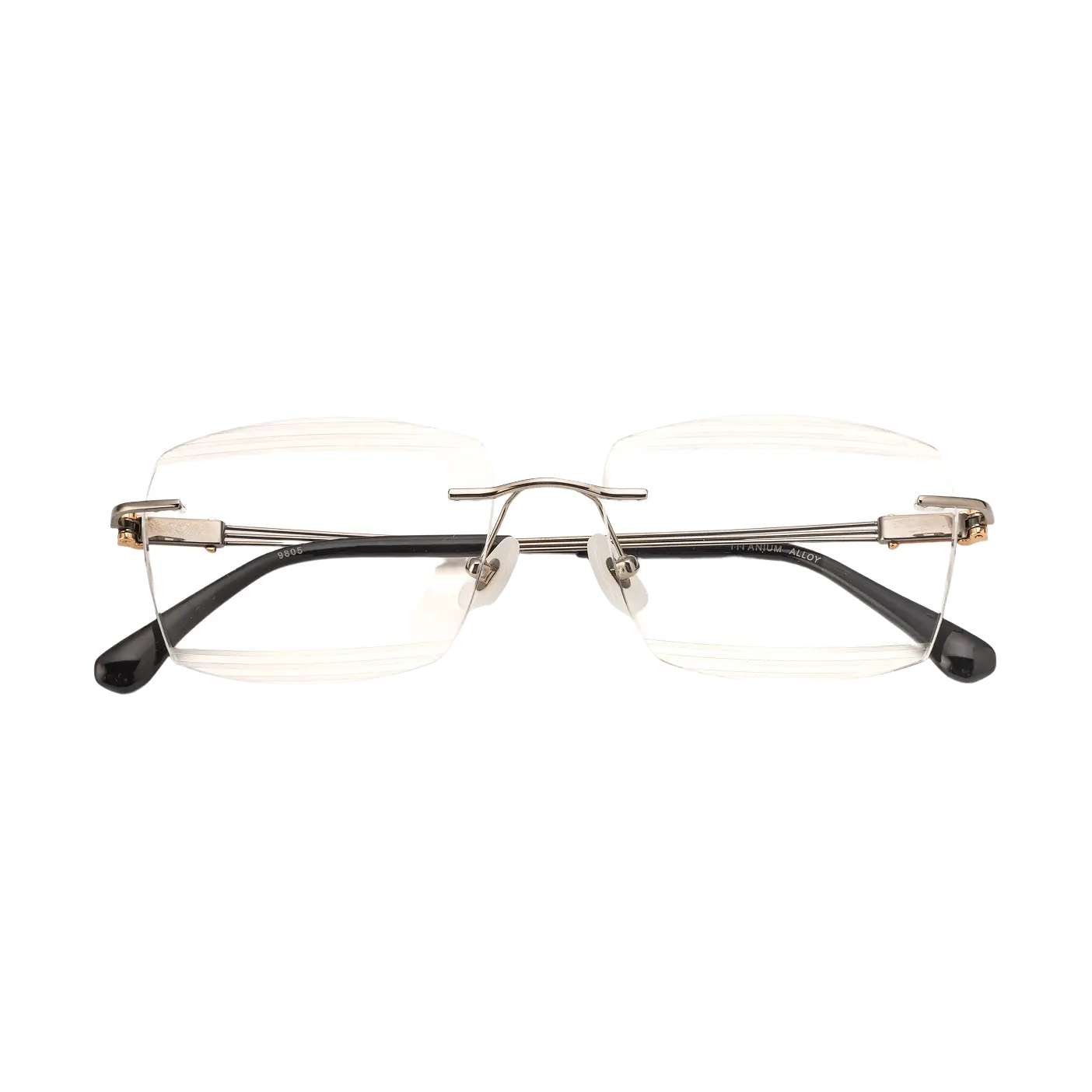
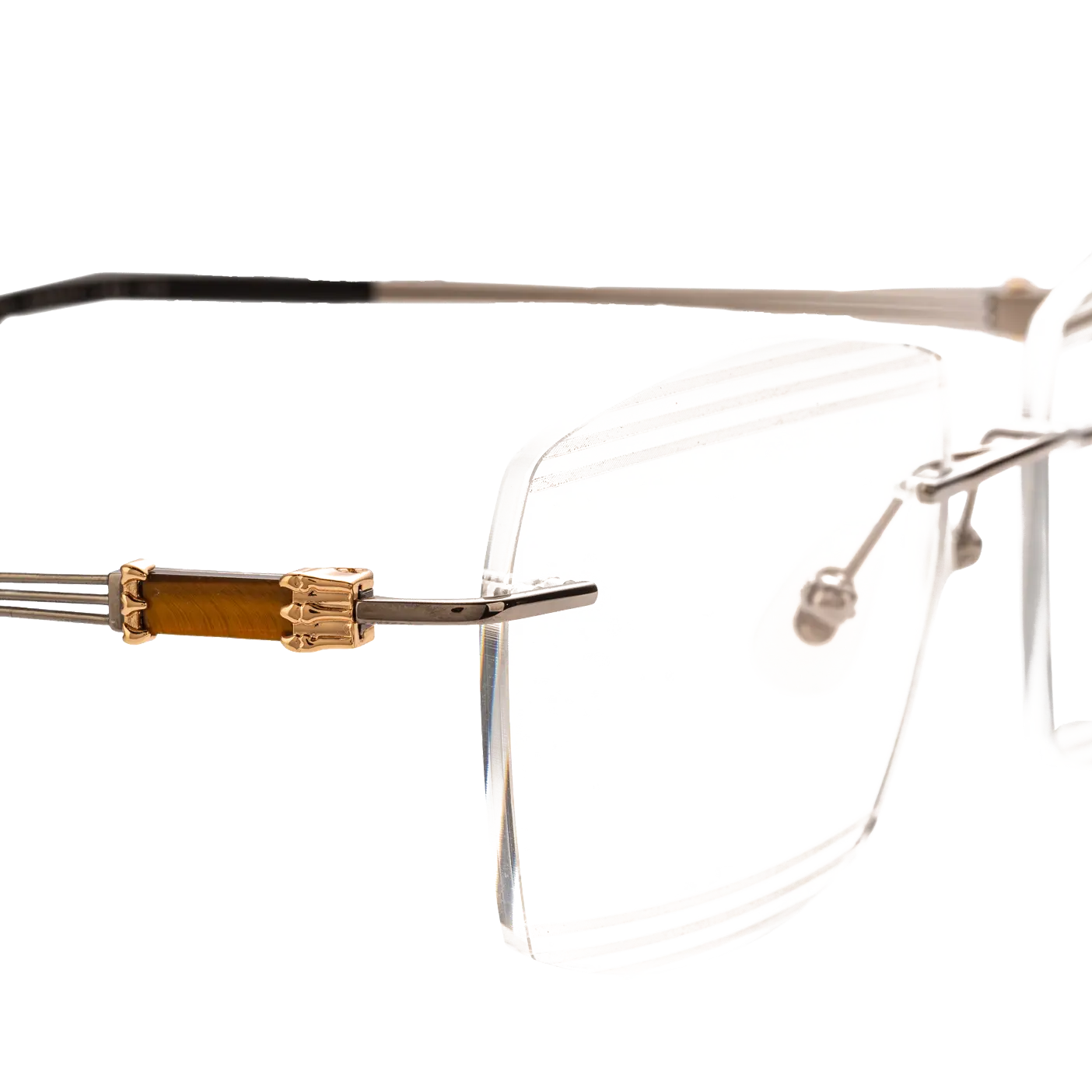
The natural material tradition has not disappeared entirely. The Gold Wood Rimless Glasses connects to that history — organic material worked with precision hardware — the same combination of craft and science that produced the first spectacles in medieval Italy.
Hands-Free Comfort — The Temple Arm

For roughly 430 years after the first spectacles were made wearers balanced them on the nose or held them by hand. In 1727 London optician Edward Scarlett added rigid arms that rested over the ears — the design we still use today.
That single addition changed eyewear from a tool that required concentration to keep in place to something that could be worn continuously through a working day. It seems obvious in retrospect. It took four centuries.
Benjamin Franklin and Bifocals

Benjamin Franklin was not a vision scientist. He was a practical man who was frustrated by switching between two pairs of glasses — one for reading and one for distance. In 1784 he solved his own problem by cutting both lenses in half and having them joined in a single frame.
His solution — the bifocal — placed the distance prescription in the upper portion and the reading prescription in the lower. The visible line between the two zones became the defining characteristic of bifocals for two centuries until progressive lenses removed it in 1959.
Modern Eyeglasses Innovations

The 2026 frame is a different object from anything the 13th-century glassmakers of Venice could have imagined — and yet it exists because of them.
Materials — Bio-Acetate and Titanium

Premium eyewear in 2026 uses plant-based bio-acetate derived from wood pulp and cotton — a sustainable alternative to petroleum-based plastic that matches traditional acetate in color depth and surface quality. Titanium frames offer a combination of extreme lightness and corrosion resistance that no earlier material achieved. The Geometric Rimless Glasses uses this precision metal construction — the kind of engineering that would have been unthinkable before the 20th century.
Lens Technology — From Glass to High-Index

Modern lenses bear almost no resemblance to the polished quartz of medieval reading stones. High-index 1.74 lenses refract light at a steeper angle which allows the same corrective power in a significantly thinner lens. Anti-reflective coatings block surface reflections. Blue-light filtering layers reduce the high-energy light from digital screens. Photochromic treatments darken in UV light.
Each of these is a layer of additional function added to what is still at its core the same optical principle that Ibn al-Haytham described in 1011 AD.
Smart Glass Technology

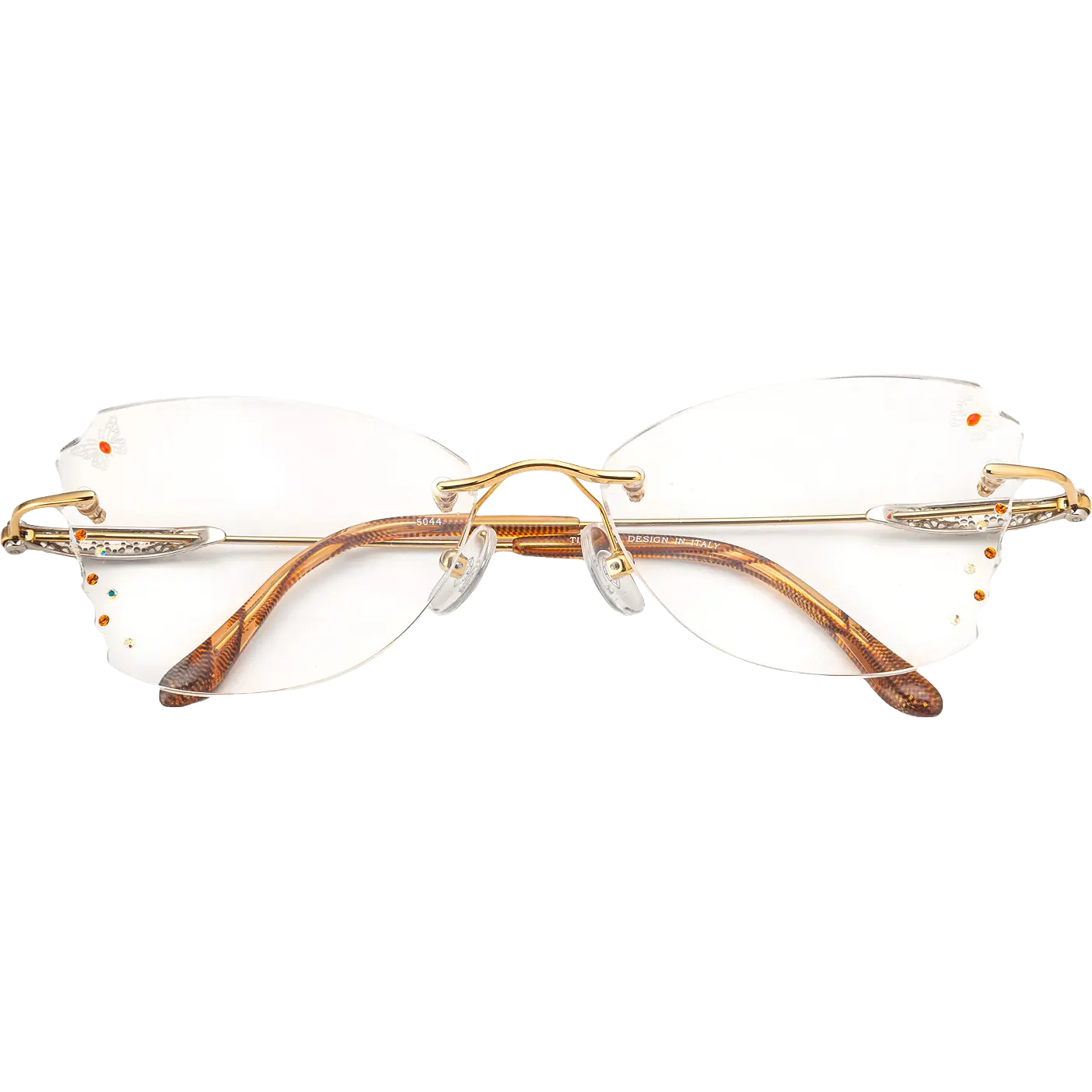
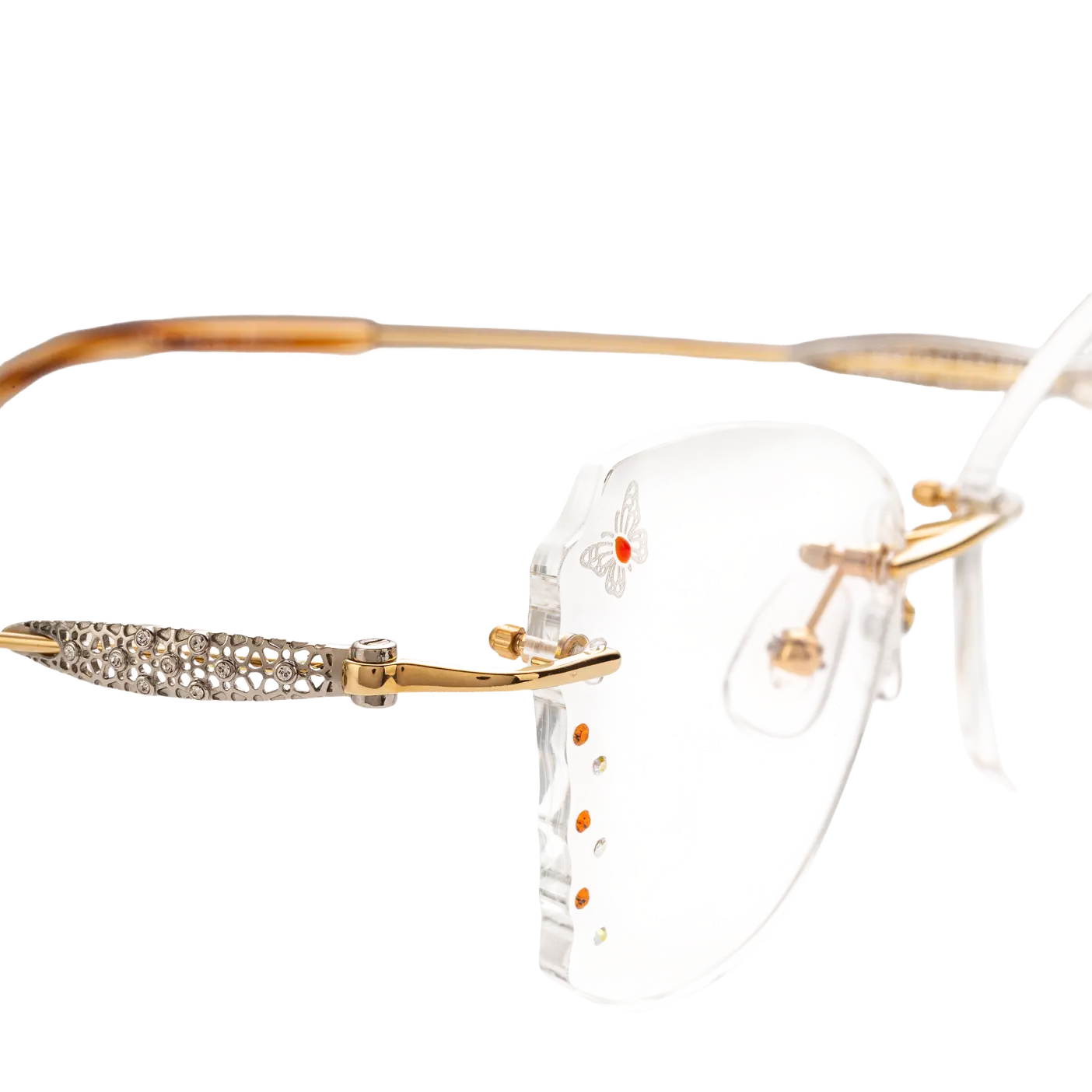
The most recent development is tech integration that is genuinely invisible in the frame. AR micro-displays that fit inside standard-looking lenses. Health tracking sensors built into temple arms. Bone conduction audio without visible speakers. The New Luxury Rimless Glasses collection represents the current quality standard — frames where the construction is precise enough to accommodate new lens technologies as they develop.
The History of Sunglasses

Sun protection for the eyes predates corrective eyewear by centuries. The approaches were creative.
Origins of Sunglasses and Early Tinted Lenses
The earliest sun protection devices were not glasses in any recognizable sense. Inuit peoples in the Arctic carved goggles from walrus bone or ivory with thin horizontal slits to reduce snow glare. No lens — just a narrowed visual field that cut the reflected brightness from ice.
The first use of an actual tinted viewing medium occurred in 12th-century China. Flat panes of smoky quartz were worn by judges in court — not to protect against sun but to prevent witnesses from reading their expressions during questioning. The tinted lens as a concealment tool rather than a medical one.
In 1752 English optician James Ayscough began experimenting with blue and green tinted glass as a potential treatment for specific vision conditions. He was not trying to make sunglasses. But he established the practice of tinting glass for optical wear.
Invention and Popularity of Sunglasses
The modern mass-market sunglass was created by Sam Foster in 1929. He sold the first commercial pairs on the Atlantic City boardwalk and found immediate demand from beachgoers looking for practical sun protection. The connection between sunglasses and leisure — and by extension glamour — was established almost immediately. Hollywood amplified it. The Luxury Glasses Frames collection reflects where that glamour tradition now sits in 2026 — quality construction with visual presence.
Aviator Sunglasses and Modern Styles

The aviator sunglass was not a fashion choice. It was a military specification. US Army Air Corps pilots flying at high altitude needed a lens that covered the full orbital area of the eye and reduced glare without distorting color perception. Bausch and Lomb developed the solution in 1936 to 1937 — the teardrop-shaped lens in green-gray glass and a lightweight metal frame.
When these were released to the public as Ray-Bans in 1937 they became an immediate commercial success. The connection between military credibility and consumer appeal has kept the aviator in production ever since. The 2026 version uses the same silhouette with significantly more refined materials — titanium instead of early lightweight metal bio-acetate instead of the original plastic. The Designer Rimless Glasses collection carries this same evolution — classic shapes built with contemporary construction.
Frequently Asked Questions
Who first invented glasses?
There is no single inventor with a confirmed patent. The first wearable spectacles appeared in Northern Italy between roughly 1268 and 1300 — probably created by an anonymous artisan or monk in the glassworks of Venice or Pisa. The scientific groundwork was laid earlier by Ibn al-Haytham in his 11th-century Book of Optics.
Did Muslims invent glasses?
Muslim scholars made essential contributions to the science behind glasses. Ibn al-Haytham's Book of Optics — written around 1011 AD — provided the first accurate description of how curved lenses work and how light enters the eye. This text was translated into Latin in the 13th century and directly informed the creation of the first European spectacles.
Did Leonardo da Vinci invent glasses?
No. Leonardo da Vinci did sketch concepts related to optics and vision aids but he was born in 1452 — well after the first wearable spectacles appeared in Italy around 1268 to 1300. He is associated with early contact lens concepts but not with the invention of spectacles.
What is the old name for glasses?
Early glasses were called spectacles — from the Latin spectaculum. Before that wearable versions were sometimes called rivet spectacles for the pin that joined the two lenses. In Italian the early term was occhiali. Reading stones were called vitrum ad legendum in Latin which translates roughly as glass for reading.
Did glasses exist in the 1600s?
Yes and they had improved significantly by then. Concave lenses for nearsightedness were introduced in the 1500s. By the 1600s glasses were available across Europe though still expensive and hand-crafted. Spanish craftsmen were experimenting with silk ribbon ear loops during this period which eventually led to the temple arm design.
Did glasses exist in 1920?
Yes and they had already shifted from pure medical implement to fashion accessory by then. The 1920s saw the rise of celluloid and acetate frames in new shapes and colors. Hollywood stars began wearing sunglasses around this period and the eyewear industry was expanding rapidly into mass production.
What makes glasses designer?
At the quality end designer glasses are defined by material and construction — proprietary hinge mechanisms hand-finished acetate precise optical alignment and longer-wearing durability. Brand recognition is part of it but the underlying difference between a designer frame and a standard one is usually in how the frame holds its shape over time and how the lenses are set.
Who invented sunglasses?
The modern commercial sunglass was introduced by Sam Foster in 1929 when he sold mass-produced sunglasses on the Atlantic City boardwalk. Earlier forms existed — Inuit peoples carved slit-goggles from bone to reduce snow glare and Chinese judges wore smoky quartz lenses in the 12th century. The first tinted glass for light sensitivity was developed by English optician James Ayscough around 1752.

Looking for something else?

Best Frames for Thick Lenses (Men & Women Guide)
LEARN MORE
How to Fix Loose Glasses in 3 Simple Steps (At Home Fast)
LEARN MORE
Popular Glasses for Men 2026 Styles for Professionals
LEARN MORE
Eye Makeup with Glasses Tips for a Stunning Look
LEARN MORELooking for something else?

Who Invented Glasses and How They Changed the World
LEARN MORE
Diy Eyeglass Cleaner Guide for Crystal Clear Lenses
LEARN MORE
Best Glasses for Oblong Face Shapes
LEARN MOREYou may also like




Further reading
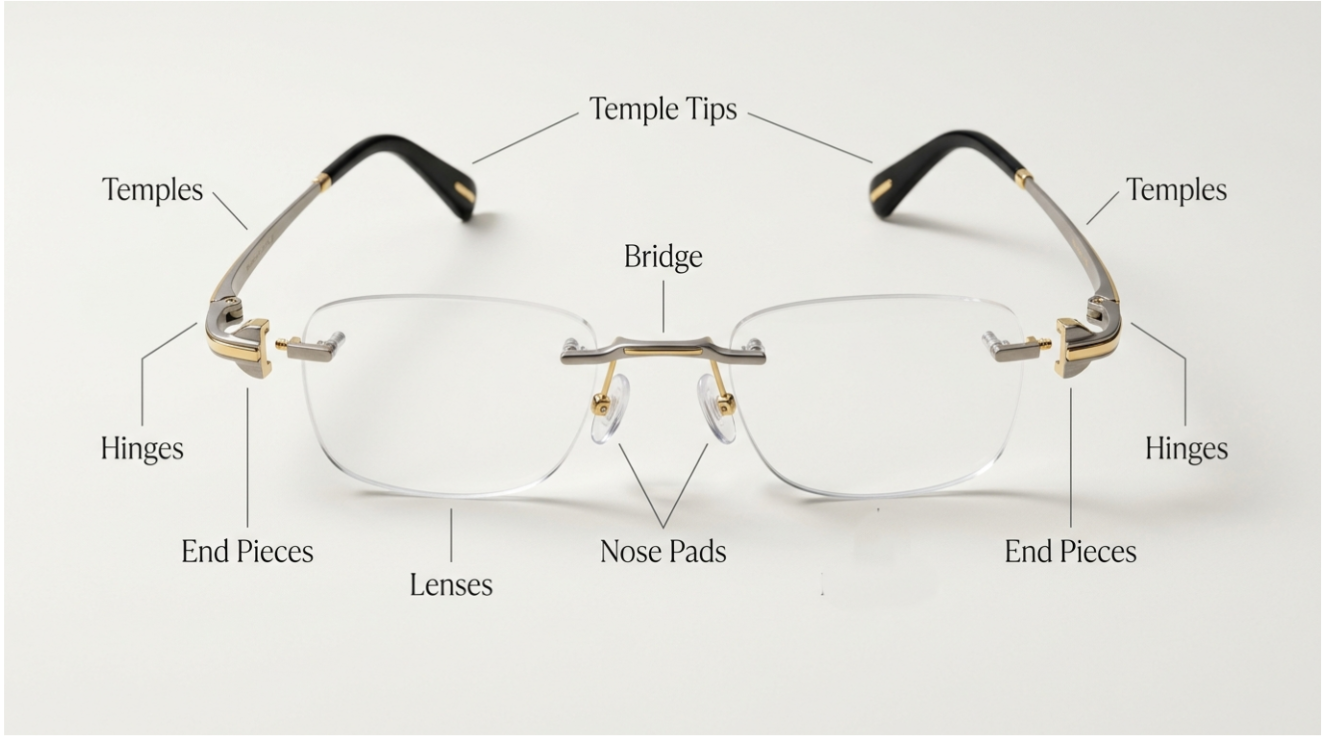
Parts of Glasses Explained: Frame, Bridge, Temple, Nose Pads and Lenses

What Are High Index Lenses and Who Needs Thinner Glasses?

Do Glasses Make Your Eyes Worse? What New Wearers Should Know