
How to Read an Eyeglass Prescription: SPH, CYL, AXIS, ADD Explained
That slip of paper from the eye exam looks like a password. OD, OS, a minus sign here, a 180 there. Nobody at the office explains it, and yet you're expected to type every field into an order form without mixing up a single number.
The good news: a glasses prescription is short. Eight fields, give or take. Each one answers exactly one question about your lenses, and once you know which question, the whole chart reads in under a minute. You'll also start catching typos before they turn into a remade pair.
|
The short version OD is your right eye, OS is your left. SPH is the main lens power — minus corrects distance vision, plus corrects near vision. CYL and AXIS work as a pair for astigmatism. ADD is the extra magnifying power for reading in bifocal or progressive lenses. PD is the distance between your pupils, and it decides where each lens is centered. Read one eye at a time, keep every sign, and never enter CYL without its AXIS. |
What the Chart Is Actually Telling You
A prescription isn't a grade for your eyes. It's a set of lens instructions, written in a unit called the diopter — the measure of how strongly a lens bends light. Zero means no correction. The farther a number sits from zero, plus or minus, the more work the lens is doing (Cleveland Clinic).

Every field on the chart belongs to one of four jobs: naming the eye, setting the main power, handling astigmatism, or adding reading support. Here's the full map.
|
Abbreviation |
Stands For |
What It Controls |
|
OD |
Oculus dexter |
Right eye — always listed first |
|
OS |
Oculus sinister |
Left eye |
|
OU |
Oculus uterque |
Both eyes (rare — most people differ per eye) |
|
SPH |
Sphere |
Main lens power, in diopters |
|
CYL |
Cylinder |
Astigmatism correction amount |
|
AXIS |
Axis |
Where the astigmatism correction sits, 1–180 degrees |
|
ADD |
Addition |
Extra near-vision power for multifocal lenses |
|
PD |
Pupillary distance |
Space between pupil centers, in millimeters |
|
Prism |
Prismatic power |
Alignment correction for double vision |
OD, OS, and OU: Which Eye Is Which?
The Latin survives because the chart has to stay compact. OD is oculus dexter, your right eye. OS is oculus sinister, your left (American Academy of Ophthalmology). The right eye comes first on the page for a practical reason — when your doctor faces you, your right eye sits on their left, so it gets written first.
OU, RE, and LE
OU means both eyes, and it only appears when one value genuinely applies to both — which isn't often, since most people carry slightly different numbers per eye. Some modern offices skip the Latin entirely and write RE and LE instead. Same rows, friendlier labels.
|
One row at a time Mixing up the OD and OS rows is the single most common ordering error, and it produces glasses that feel subtly wrong rather than obviously broken. Read across one eye completely before touching the other. |
SPH: The Number Doing the Heavy Lifting

Sphere is the main event. One number per eye, with a sign in front, and the sign tells the story.
- A minus sign (-) means nearsightedness — close objects are clear, distance is blurry, and the lens corrects for that.
- A plus sign (+) means farsightedness — distance is the comfortable zone, and near work needs help.
So what does +2.00 mean? Two diopters of plus power for that eye. A -2.00 lens does the opposite job at the same strength. Most prescriptions land between -5.00 and +3.00, though outliers run well past that in both directions (Cleveland Clinic). “SPH” or a blank in the cylinder column simply confirms the eye needs spherical power only — no astigmatism correction.
Is +4.00 strong? Stronger than +1.00, certainly. But strength alone says little about eye health — it only says how much focusing work the lens takes on. The numbers that complete the picture come next.
CYL and AXIS: The Astigmatism Pair

Around one in three people has an eye that isn't perfectly round — closer to the curve of an egg than a sphere. Light entering that shape lands unevenly, and vision blurs at every distance. That's astigmatism, and it takes two numbers to correct.
CYL sets the amount
Cylinder is the extra power layered onto the sphere, and it carries its own plus or minus sign. A blank CYL box is good news: either no astigmatism, or too little to bother correcting. Never drop the sign when typing it in — a -1.00 and a +1.00 cylinder are different lens instructions entirely.
AXIS sets the direction
Axis is not a power. It's an orientation, written as a whole number from 1 to 180 degrees, telling the lab where on the lens the cylinder correction should sit. Think of a football resting on its side versus standing on end — same shape, different angle. Axis records the angle.
|
CYL without AXIS is an incomplete order The two fields only work together. If your chart shows a cylinder value but the axis box is empty, stop and call the office before ordering — guessing an axis number produces lenses that blur in a new direction. |
ADD: The Reading Power at the Bottom of the Lens
Somewhere in the early-to-mid 40s, the eye's natural lens stiffens and close focus gets harder. The condition is presbyopia, and it eventually reaches almost everyone (American Academy of Ophthalmology). ADD is the answer: extra magnifying power applied to the lower part of the lens so the same pair handles both your distance correction and your phone.

Two things make ADD easy to spot. It's always a plus power, even when the sign is missing. And it's almost always identical for both eyes, usually somewhere between +0.75 and +3.00.
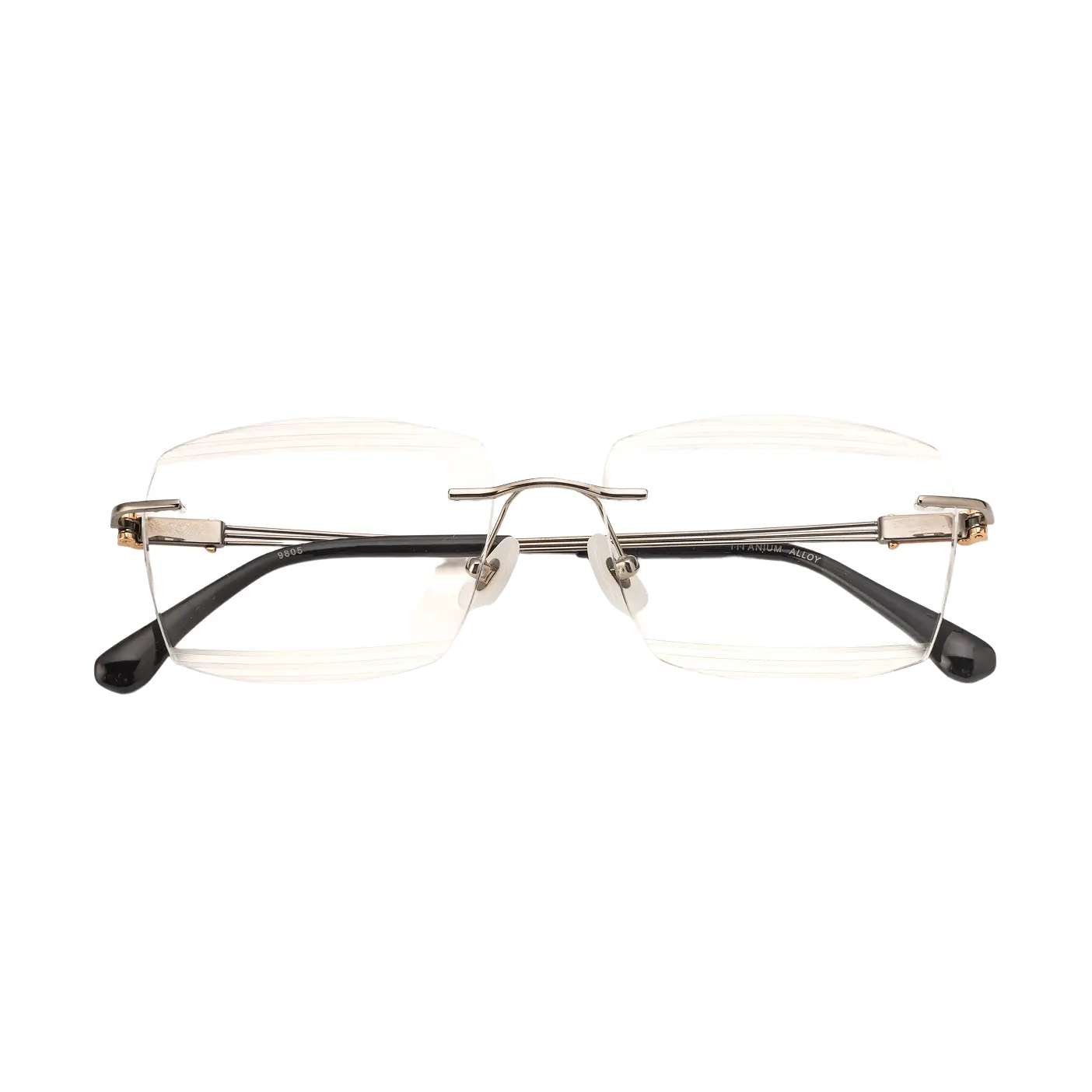
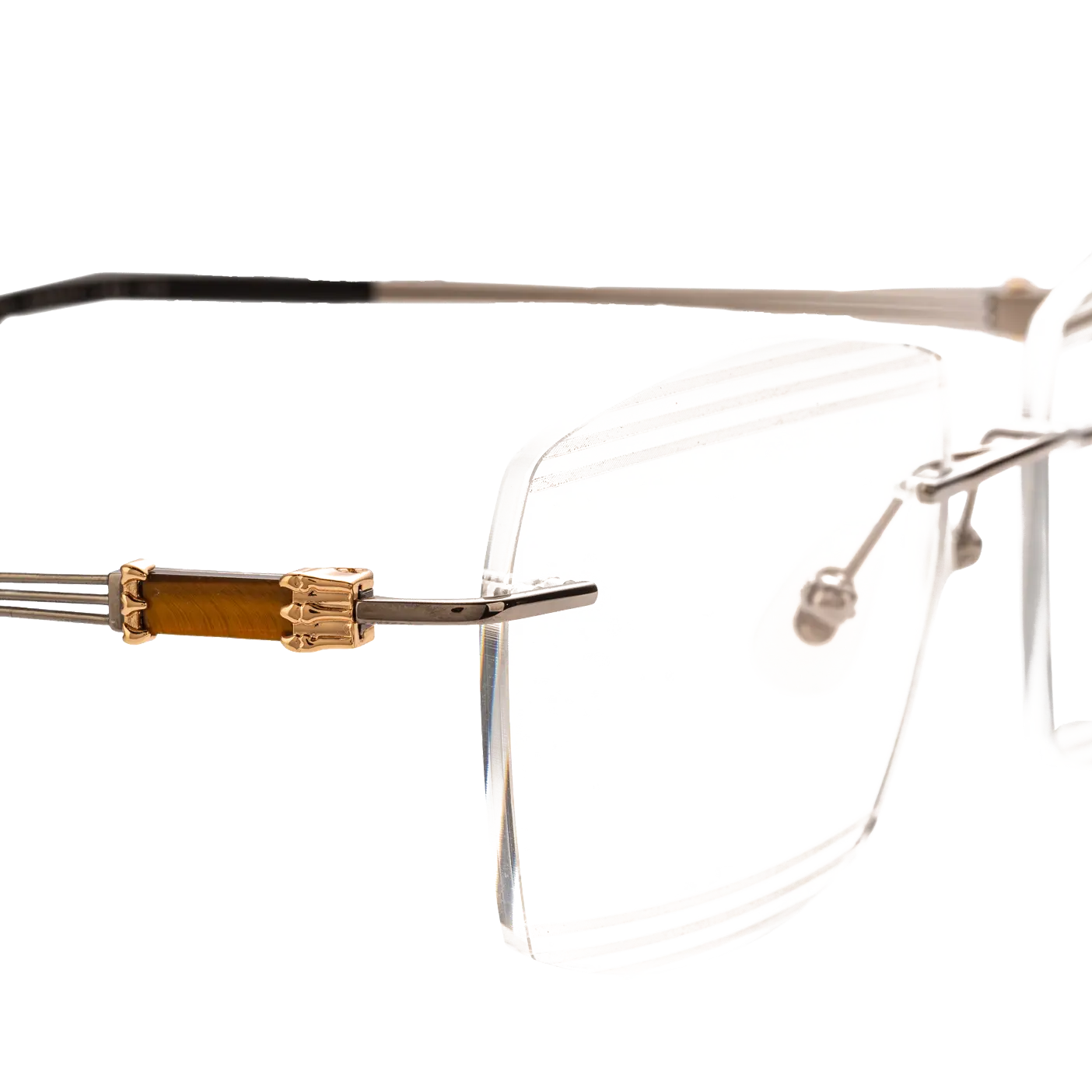
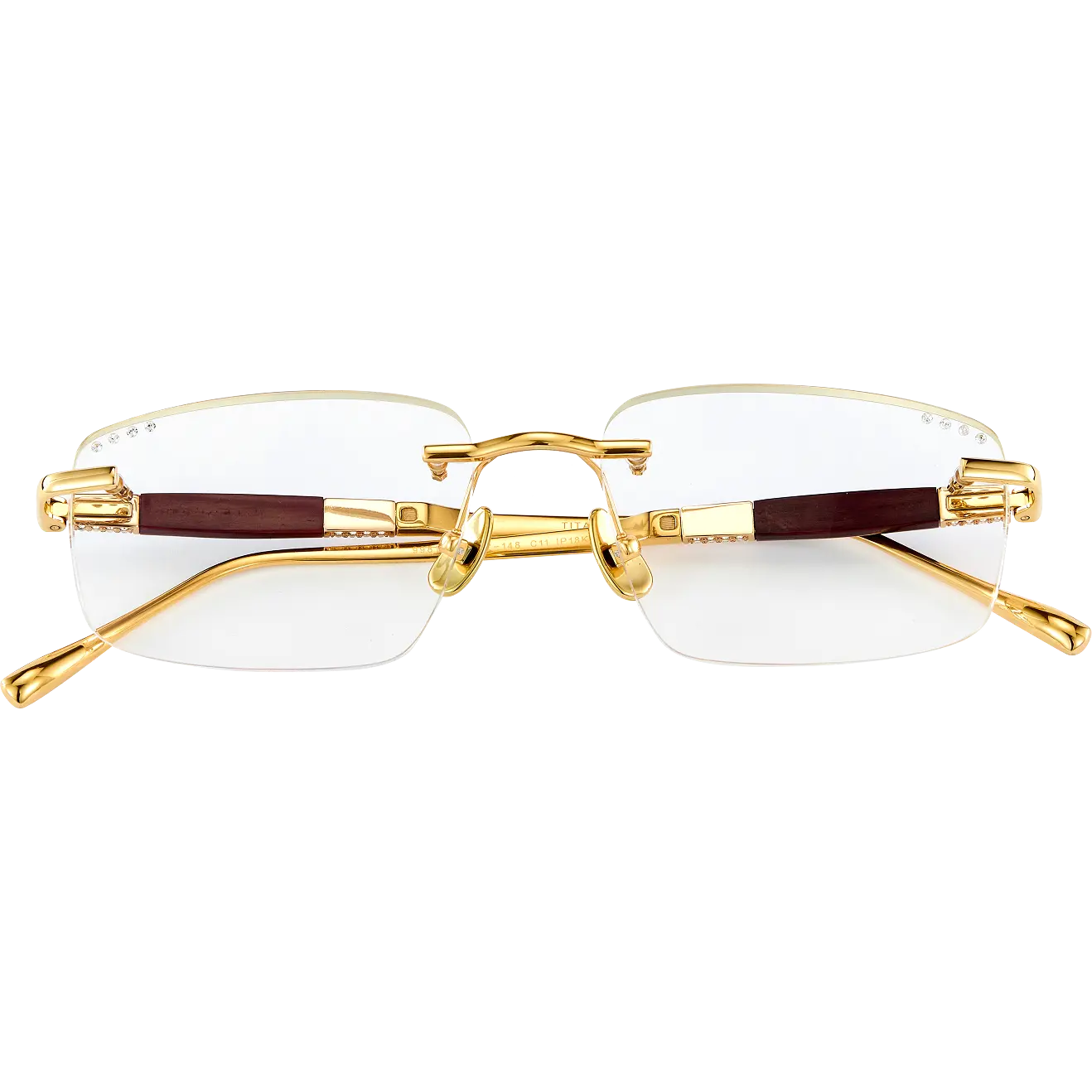
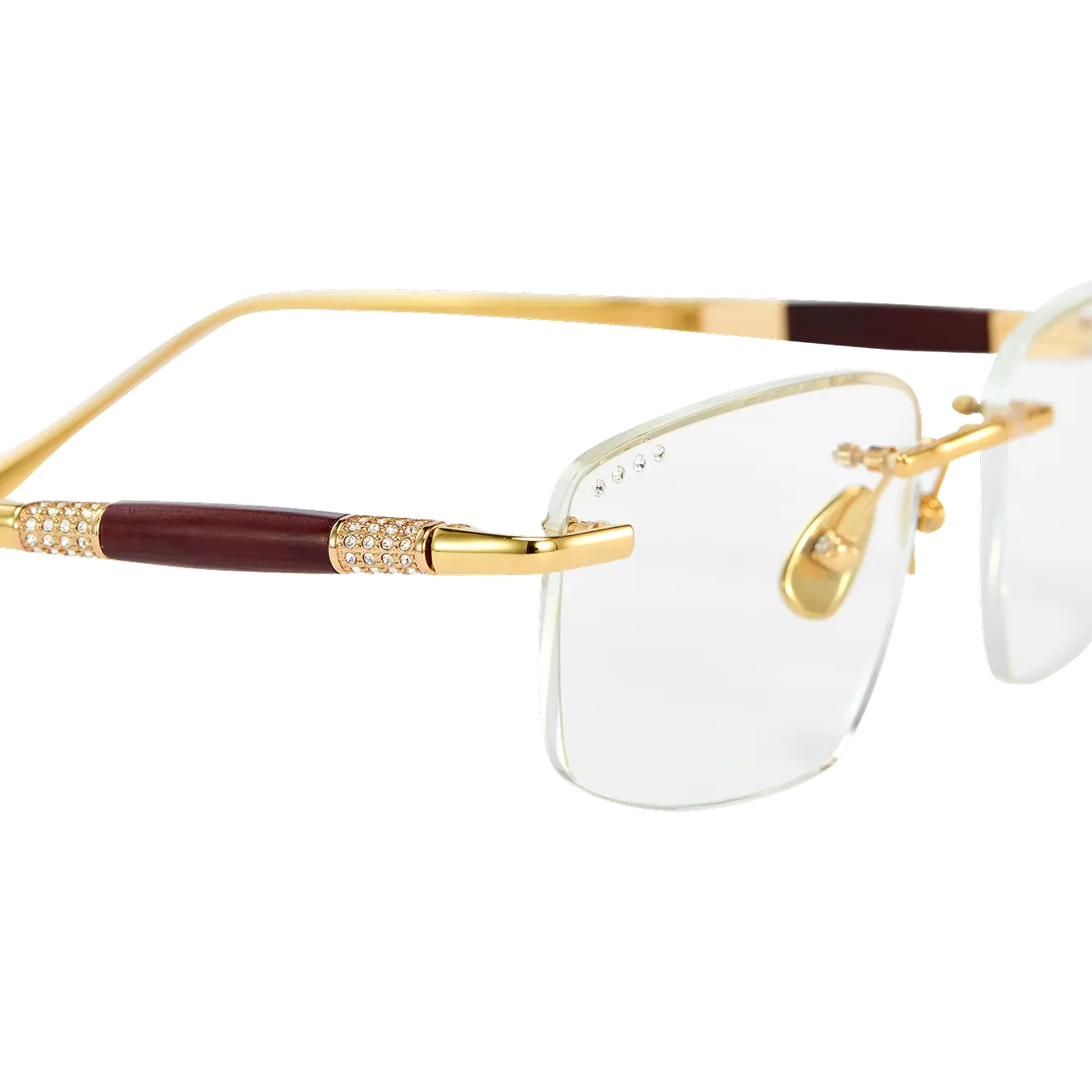
Bifocals split the lens with a visible line — distance on top, reading below. Progressives blend the two zones gradually, no line. Either way, the ADD value builds the near portion. If you wear progressives, frame choice matters more than usual: the lens needs enough vertical room for the power to transition. Rimless frames built around the prescription lens itself handle this well, since the lens shape isn't squeezed into a rim — the optics set the silhouette, not the other way around.
PD and Prism: The Small Print That Matters Online
PD — pupillary distance
PD is the millimeter distance between the centers of your pupils, and it determines where the optical center of each lens gets placed. Off-center lenses feel wrong fast — eye strain, swimmy edges, sometimes outright blur — and the effect grows with prescription strength (Cleveland Clinic). Many paper prescriptions leave PD off entirely. If yours does, ask the office to measure it rather than borrowing a number from an old pair.
Prism — for double vision
A small minority of prescriptions include prism, a correction that bends light to merge two images into one when the eyes don't align. Prism always travels with a base direction:
- BU — base up
- BD — base down
- BI — base in, toward the nose
- BO — base out, toward the ear
A prism value with no direction letter is half an instruction. Enter both, exactly as written.
A Sample Prescription, Read Line by Line
Theory is fine. A worked example is better. Here's a typical multifocal chart:
|
Eye |
SPH |
CYL |
AXIS |
ADD |
PD |
|
OD (right) |
-2.00 |
— |
— |
+1.50 |
62 |
|
OS (left) |
-1.50 |
-0.75 |
180 |
+1.50 |
62 |
Reading it out: the right eye needs 2.00 diopters of minus power for nearsightedness, with no astigmatism correction. The left eye needs slightly less main power, plus a -0.75 cylinder oriented along the horizontal 180-degree line. Both eyes get +1.50 of reading support at the bottom of the lens, and the pupils sit 62 millimeters apart. Six fields, one complete pair of progressive lenses.
So How Strong Is Your Prescription, Really?
This is where the search bar fills with worry. Is -3.50 bad? Is +2.50 a problem? Mostly, the anxiety outruns the math.
Distance from zero equals strength, nothing more. A -3.50 sits in the moderate band for nearsightedness; clinicians generally reserve “high myopia” for -5.00 and beyond, and “high hyperopia” for past +3.00 (Cleveland Clinic). None of these labels are verdicts on your eye health — they describe lens work, and your eye doctor reads them alongside the rest of your exam.
And legal blindness? That's a different measurement altogether. It's defined by best-corrected vision — typically 20/200 or worse in the better eye while wearing correction, or a severely narrowed visual field. A person with a -5.75 prescription who sees clearly through their lenses is nowhere near that definition. The prescription number alone can't tell you.
One more decoder while we're here: 20/20 means you read at 20 feet what a standard eye reads at 20 feet. 20/30 means you need to stand at 20 feet to read what that standard eye catches from 30. It measures sharpness on a chart — separate from the diopters on your prescription.
Worth knowing for stronger numbers: lens material matters as much as the frame. A high-index lens keeps a -5.00 prescription noticeably thinner than standard material, which is how strong corrections stay comfortable in a minimal, rimless silhouette.
Five Mistakes That Spoil an Online Order
Nearly every botched online glasses order traces back to one of five entry errors. All five are avoidable in about a minute of checking.
- Swapped eyes. OD goes in the right-eye field, OS in the left. Finish one row before starting the next.
- A dropped sign. Plus and minus lenses do opposite jobs. Type the sign exactly as written, on both SPH and CYL.
- CYL entered without AXIS. They're a pair. Most order forms will block checkout; don't fill the gap with a guess.
- Using a contact lens prescription. Contacts sit on the eye, glasses sit roughly 12 mm in front of it, so the powers differ. The two prescriptions aren't interchangeable.
- Ignoring PD. Centering is comfort. If the number's missing, get it measured — don't reuse a stranger's average.

Accuracy carries extra weight with rimless eyewear, where the lenses are drilled and mounted directly using a precision-drill technique — the lens is the structure, so the numbers shaping it need to be right the first time. It's also why a strong prescription doesn't rule out a minimal frame: paired with a high-index lens, a lightweight titanium frame that carries strong lenses without visual bulk keeps the focus on your face rather than on the correction sitting in front of it.
Your Prescription Is Yours to Keep
In the United States, this part is settled law. The FTC's Eyeglass Rule requires eye doctors to hand you a copy of your prescription immediately after any exam that includes a refraction — without being asked, without an extra fee, and without any obligation to buy from them. You're free to fill it wherever you choose, in person or online. So if the front desk hesitates, ask plainly. The copy is yours.
Prescriptions do expire, usually after one to two years depending on the state. Check the date before ordering, and treat an expiring prescription as a nudge toward your next exam — vision shifts quietly, and the chart should keep up.
Conclusion
Read one eye at a time. Keep every sign. Pair CYL with AXIS, treat ADD as your reading number, and get a real PD measurement instead of a guess. That's the entire skill — eight fields, each answering one question, and a chart that stops looking like code the second time you see one.
With the numbers decoded, the pleasant part begins: choosing what they'll live in. The full Bling Optical rimless collection is prescription-ready across the range — nearsighted, farsighted, progressive, and Blue Cut lens options — with free shipping on all orders and a 14-day satisfaction guarantee while you settle in with the fit.
FAQs
How do I read my prescription for eyeglasses?
Start at OD (right eye) and read across: SPH for main power, CYL and AXIS for astigmatism, ADD for reading, then PD. Repeat for OS. Every sign matters, so copy them exactly when ordering.
What does +2.00 mean on an eye prescription?
Two diopters of plus power for that eye. Under SPH, it corrects farsightedness; under ADD, it's the reading boost in a bifocal or progressive lens. The column it sits in decides the job.
Is a +2.50 eye prescription bad?
No — it's a moderate plus correction, nothing alarming on its own. What it means for you depends on age, symptoms, and the rest of your exam, which is your eye doctor's territory.
Is minus 5.75 legally blind?
Not from the number alone. Legal blindness is judged on best-corrected vision (around 20/200 or worse) or a severely narrowed field — and someone at -5.75 typically sees well with their lenses on.
How bad is minus 3.5 eyesight?
Moderate nearsightedness — distance is blurry without correction, but lenses handle it routinely. Clinicians usually reserve the “high myopia” label for -5.00 and beyond.
Is +4.00 a strong prescription?
Yes, it sits past the +3.00 mark often described as high hyperopia, so lens choice and centering matter more. A high-index lens keeps it thin — prescription-ready rimless glasses for women pair well with that combination.
Can you get +5 reading glasses?
Off-the-shelf readers do exist at +5, but they can't handle astigmatism or different powers per eye. At that strength, an exam and custom lenses are the safer route.
What does 20/20 and 20/30 vision mean?
20/20 means you read at 20 feet what a standard eye reads at 20 feet; 20/30 means you need 20 feet for what that eye reads at 30. It measures chart sharpness, not lens power — frames across the men's rimless range accept the full spread of prescriptions either way.
Sources
- American Academy of Ophthalmology, How to Read an Eyeglasses Prescription
- Cleveland Clinic, How To Read Your Eye Prescription
- American Academy of Ophthalmology, What Is Presbyopia?
- Federal Trade Commission, Eyeglass Rule
- Federal Trade Commission, Buying Prescription Glasses or Contact Lenses: Your Rights

Looking for something else?

Best Frames for Thick Lenses (Men & Women Guide)
LEARN MORE
How to Fix Loose Glasses in 3 Simple Steps (At Home Fast)
LEARN MORE
Popular Glasses for Men 2026 Styles for Professionals
LEARN MORE
Eye Makeup with Glasses Tips for a Stunning Look
LEARN MORELooking for something else?

Who Invented Glasses and How They Changed the World
LEARN MORE
Diy Eyeglass Cleaner Guide for Crystal Clear Lenses
LEARN MORE
Best Glasses for Oblong Face Shapes
LEARN MOREYou may also like




Further reading
Parts of Glasses Explained: Frame, Bridge, Temple, Nose Pads and Lenses

What Are High Index Lenses and Who Needs Thinner Glasses?

Do Glasses Make Your Eyes Worse? What New Wearers Should Know