How to Measure Pupillary Distance at Home (The Accurate Way)
You ordered your new glasses online. They arrived, and they look great. But the moment you put them on, something feels off.
Most of the time, the culprit is not a bad prescription. It is an incorrect pupillary distance.
Waiting for a beautiful new pair of frames, only to feel dizzy when you wear them, is frustrating. But this is completely fixable and takes under 2 minutes at home. You do not need another appointment. Here is exactly how to measure pupillary distance (PD) accurately so you can order your next pair from Bling Optical with total confidence.
|
Quick PD Facts |
|
Adult PD range: 54 – 74 mm |
|
Child PD range: 43 – 58 mm |
|
Accuracy tolerance: ±1–2 mm for single-vision lenses |
What Is Pupillary Distance and Why Does It Matter?

Pupillary distance is the space in millimeters between the centers of your two pupils. But it is far more than a sizing metric.
Every prescription lens has an optical center — the exact spot where your vision correction is sharpest. For glasses to work as your optometrist intended, the optical center must align with your pupil. If the PD is wrong, you are looking through the wrong part of the glass.
When alignment is off by even 2 to 3 millimeters, your eyes are forced to work harder. The result is persistent eye strain, tension headaches, blurred edges, or a mild feeling of vertigo.
An accurate interpupillary distance matters for all eyewear, but it is critical if you wear progressive lenses or have a high prescription. When you invest in a pair of rimless prescription glasses from collections like Rimless Glasses for Women or Rimless Glasses for Men, getting the PD right is the only way to guarantee crisp, effortless clarity.
Single PD vs Dual PD — Which One Do You Need?

The most common source of confusion for first-time online buyers is seeing two formats.
Single PD — also called binocular PD — is one total number measuring the full distance between both pupils.
Dual PD — or monocular PD — is a pair of numbers, such as 32/30. It measures a pupil's distance from the center of the nose bridge separately. The right eye is always listed first.
A single PD works for most standard prescriptions. Because faces are rarely perfectly symmetrical, a dual PD is the preferred standard for progressive lenses and high-power prescriptions. Most online retailers accept either format, so do not worry if your doctor gave you two numbers instead of one.
How to Calculate Near PD for Reading Glasses
Subtract 3 mm from your single distance PD to get your near PD.
When you look at something close up, your eyes naturally turn inward slightly. Reading glasses need a narrower PD to account for that.
- Single PD example: distance PD of 64 mm becomes near PD of 61 mm.
- Dual PD example: distance measurements of 32/32 become near PD of 30.5/30.5.
Check Your Prescription First

Before you reach for a ruler, look at your existing prescription. Your PD may already be listed in a dedicated box or the notes section.
If it is not there, it may have been intentionally left off. Many optometrists consider PD a dispensing measurement rather than a medical one. The FTC Eyeglass Rule requires them to provide your prescription, but does not strictly require that PD be included.
A quick visit to a cardiometrist's office is often the fastest path if they have made glasses for you before; they have the number on file and will usually give it over the phone.
How to Measure Your PD at Home — 3 Methods

If your prescription is blank and you are ready to order, here are the three most reliable ways to measure at home.
Method 1 — Mirror and Ruler (Solo)
What you need: a millimeter ruler and a well-lit mirror.
- Stand about 8 inches from the mirror in good light.
- Hold the ruler flat against your browline.
- Close your right eye and align the 0 mm mark with the center of your left pupil.
- Open your right eye and close your left eye without moving the ruler.
- Read the millimeter mark that lines up with your right pupil. That is your PD.
|
Smart tip — mirror method |
|
Measure three times and average the readings. If all three are within 1 mm of each other, you have a reliable result. |
|
No mm ruler at ho'e? Search 'printable mm ruler for eyeglasses' and print at 100% scale. |
Method 2 — With a Friend (Most Accurate)

This is the approach recommended by the U.S. Department of Veterans Affairs eye care guidelines. A second pair of hands removes parallax error and keeps your gaze in a natural, relaxed position.
What you need: a millimeter ruler and a helper.
- Sit or stand across from your friend. Look past them at a fixed point 10 to 20 feet away. This stops your eyes from converging inward.
- Have your friend hold the ruler flat just above your eyes along your browline.
- They align the 0 mm mark with the center of one pupil and read the distance to the other.
- Keep your gaze fixed while they repeat the process three times and average the readings.
Method 3 — Old Glasses and a Marker

If you own a pair of glasses that feel comfortable, you can use them as a template. This works well as a cross-check for a ruler reading.
What you need: your current glasses, a non-permanent marker, and a ruler.
- Put your glasses on and focus on something at least 20 feet away.
- Have a friend make a small dot on each lens directly over your pupils.
- Remove the glasses and measure the distance between the two dots in millimeters.
- Clean the dots off immediately with a damp cloth.
Method Comparison — Which Is Most Accurate?
Not every method offers the same level of precision. For a single-vision prescription, the mirror method is more than enough. For progressive lenses or a high prescription, the friend method is the gold standard.
|
Method |
Accuracy |
Best For |
What You Need |
|
Mirror + ruler |
Good ±1–2 mm |
Single-vision Rx |
mm ruler, mirror |
|
Friend + ruler |
Best ±0.5 mm |
Progressives, high Rx |
mm ruler, helper |
|
Old glasses + marker |
Good cross-check |
Verification |
Glasses, marker, ruler |
|
Smartphone app |
Good ±1 mm |
Quick / no ruler |
iPhone X or Android |
If you are ordering from the Gold Rimless Glasses collection or any frame that will hold a progressive lens, ask a friend to help. The extra 30 seconds is worth it.
No Ruler? App and Printable Options

If you do not have a millimeter ruler, you still have good options.
- PrintaWe’ve made it easy: download our official Bling Optical PDF ruler, print it at 100% scale, and use it just like a plastic ruler. Place it across your browline, follow the same steps as the mirror, and you’ll have an accurate reading in seconds. This keeps everything on our site—no need to visit other retailers.
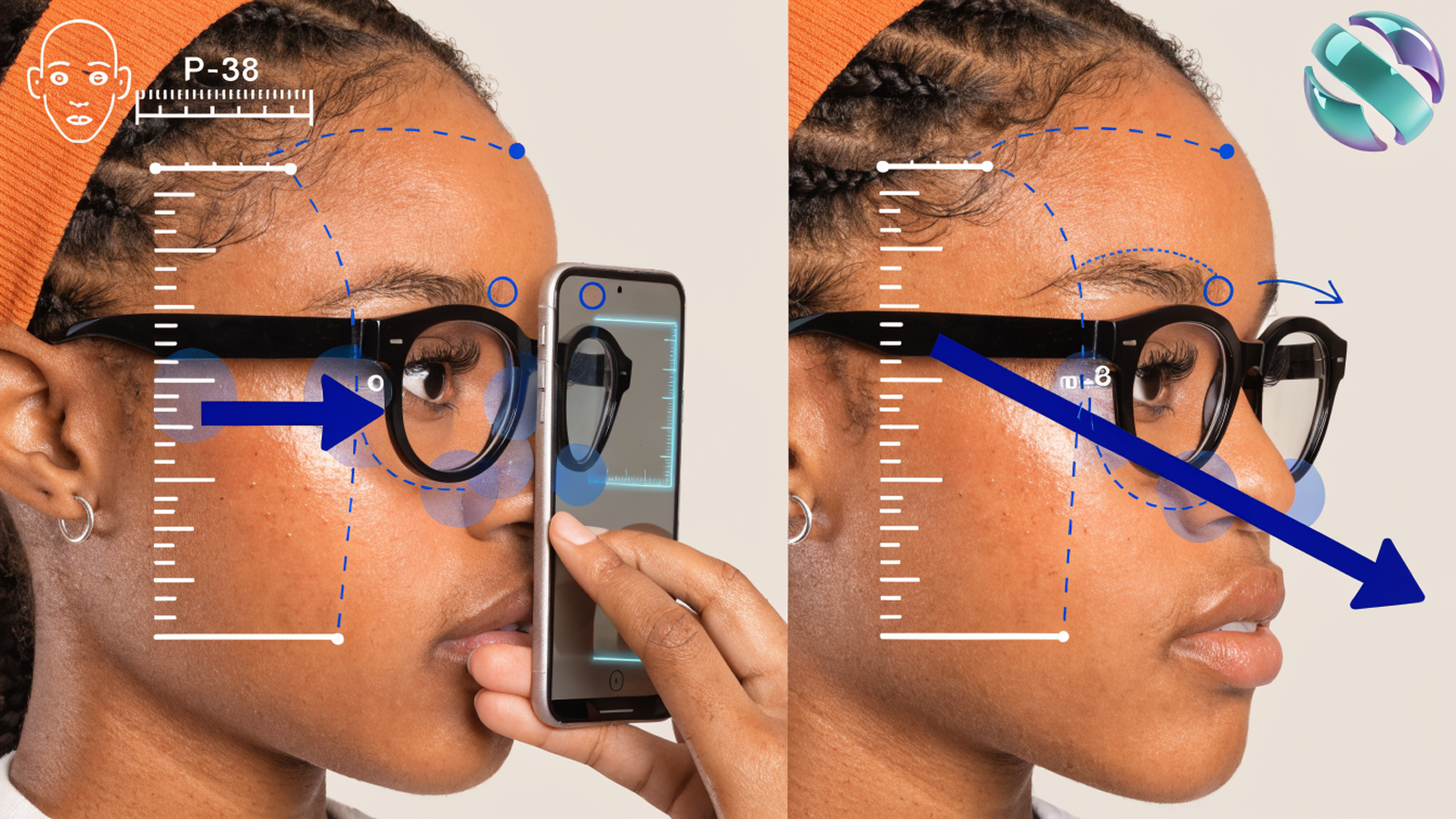
- GlassesOn: For a tech-savvy option, our site is integrated with GlassesOn. After clicking Virtual Try-On, look at the top-left "orner for “Meas" re Your PD”. The app uses your phone camera to scan your face and returns a PD measurement in seconds. It’s quick, accurate, and works perfectly with our frames.
- EyeMeasure: Available for iPhone X and newer. Uses Face ID sensors for facial mapping. Accurate to within roughly 1 mm.
- EyeQue PD Check: Free on both platforms. Measures far and near PD separately, useful if you need reading glasses too.
App accuracy is fine for single-vision lenses. For progressive or high-prescription lenses, confirm the app result with a ruler before ordering.
Common PD Mistakes to Avoid
Small errors lead to a blurry experience. Here are the ones that come up most often.
- Moving your eyes between readings. Always fix your gaze on one point. Eye movement shifts the result.
- Measuring only once. Take three readings and average them. One reading is not reliable enough.
- Tilting the ruler. The ruler must sit flat and level across your browline. Any angle adds error.
- Mixing up distance PD and near PD. They are different numbers for different glasses. Subtract 3 mm for reading glasses.
- Ignoring asymmetry. If your face is noticeably asymmetric, use the friend method to get a dual PD rather than a single number.
Once you have your number, explore the full range at Gold Oval Rimless Glasses and beyond — frames designed to be worn as precisely as they are styled.
Frequently Asked Questions
How do I know my pupillary distance?
Check your prescription first — it may already list your PD. If not, call your optometrist and ask. They almost always have it on file. If you still cannot get it, the mirror method takes under two minutes and works for most prescriptions.
Is a PD of 72 normal?
72 mm sits at the upper end of the adult range, which runs from 54 to 74 mm. It is not unusual, especially for men who tend to have slightly wider measurements. If an online retailer flags it, confirm with your optometrist.
How is PD calculated?
PD is the distance in millimeters between the centers of both pupils. Hold a ruler flat across your browline, align the zero with one pupil, and read the mark at the other. Take three readings and average them for the most reliable result.
Can I measure my PD with my phone?
Yes. Apps like GlassesOn (iOS and Android) and EyeMeasure (iPhone X and newer) use your camera to estimate PD within about 1 mm. That is fine for single-vision lenses. For progressive lenses, a ruler measurement is more reliable.
Is 70 a normal PD for glasses?
70 mm falls within the normal adult range. Enter it with confidence when ordering online. If you wear progressive or high-prescription lenses, double-check it using the friend method before placing your order.
Can I use a photo to measure PD?
Some apps use a selfie alongside a reference object, such as a credit card, to estimate PD. The result is reasonable for standard lenses. For complex prescriptions, the ruler method gives a more accurate reading.
What does +2.75 mean for glasses?
It is the sphere value on your prescription and indicates farsightedness. The higher the number, er the stronger the correction needed. It does not directly change your PD check, but a higher prescription makes accurate PD measurement even more important.
How to tell if your vision is 20/40?
A 20/40 reading means you see at 20 feet what someone with normal vision sees at 40 feet. Only an optometrist can confirm this through a chart test. If you notice blurring at a distance, book an eye exam.

Looking for something else?

Best Frames for Thick Lenses (Men & Women Guide)
LEARN MORE
How to Fix Loose Glasses in 3 Simple Steps (At Home Fast)
LEARN MORE
Popular Glasses for Men 2026 Styles for Professionals
LEARN MORE
Eye Makeup with Glasses Tips for a Stunning Look
LEARN MORELooking for something else?

Who Invented Glasses and How They Changed the World
LEARN MORE
Diy Eyeglass Cleaner Guide for Crystal Clear Lenses
LEARN MORE
Best Glasses for Oblong Face Shapes
LEARN MOREYou may also like


Further reading
Parts of Glasses Explained: Frame, Bridge, Temple, Nose Pads and Lenses

What Are High Index Lenses and Who Needs Thinner Glasses?
Do Glasses Make Your Eyes Worse? What New Wearers Should Know