


How to Read a Glasses Prescription: OD, OS, SPH, CYL, Axis and ADD
This guide walks through every code on a glasses prescription — OD, OS, SPH, CYL, Axis, ADD, and PD — so you can read your own numbers and order lenses without second-guessing them.
Most people get handed their prescription, glance at the grid, and quietly decide it’s the optician’s problem to understand. Then they sit down to order glasses online and that little slip suddenly matters a lot. Here’s the reassuring part: it’s only six or seven codes. Learn what each one means once, and the whole thing reads in about thirty seconds — for the rest of your life.
What a Glasses Prescription Actually Tells You
A prescription is a set of instructions for one job: bending light so it lands correctly inside your eye. Your optometrist works it out during the exam by testing how your eyes focus, then writes the result as lens powers a lab can cut. That’s the entire purpose of the document — nothing more mysterious than a recipe.
What it doesn’t do is diagnose disease. A prescription won’t tell you whether you have glaucoma or cataracts; it covers refractive errors only — nearsightedness, farsightedness, astigmatism, and the age-related reading shift called presbyopia. The exam itself can still flag bigger health signals, since the eye is one of the few places a doctor sees blood vessels directly, and changes there sometimes point to diabetes or high blood pressure. Same visit, two different things.
Why It’s Laid Out as a Grid

Your two eyes rarely need identical correction, so the chart keeps them apart. Rows handle the right and left eye separately. Columns hold each type of measurement, so a lab can read straight down to find every value at once. It looks busy because it crams plus and minus signs, decimals, and angles into a small space — but the logic underneath is simple: rows for eyes, columns for corrections.
-
OD and OS — your right and left eye
-
SPH — the basic lens power
-
CYL and Axis — astigmatism, when you have it
-
ADD — reading support in multifocals
-
PD — centering the lenses to your pupils
Glasses vs. Contacts — Not the Same Numbers
Worth clearing up before anything else: a glasses prescription is not interchangeable with a contact lens prescription. Glasses sit roughly 12mm off your eye; contacts sit directly on it. That small distance changes the math, so the powers often differ between the two. Contact prescriptions also add a Base Curve and Diameter so the lens fits the curve of your cornea safely (American Academy of Ophthalmology, 2023). If you order online, match the prescription to the product — feeding glasses numbers into a contact order is a fast route to blur.
OD, OS and OU: Which Eye Is Which

Before any number means anything, you need to know which eye it belongs to. The abbreviations are Latin, they’re the same across the US, and they trip people up only because they look alike at a glance.
OD = Right Eye
OD is oculus dexter, Latin for right eye — the same root that gives us “dexterity.” Every value on the OD line applies to your right eye alone. Don’t assume your two eyes match, either; plenty of people are noticeably stronger on one side, which is exactly why the rows stay separate in the first place.
OS = Left Eye
The OS is oculus sinister, the left eye. The Latin word for “left” also gives us “sinister,” but there’s nothing ominous about your left eye — it just means direction. If you have astigmatism in one eye and not the other, you’ll sometimes see CYL and Axis filled in on only one of these rows.
OU = Both Eyes
OU is an oculus uterque, both eyes together. You’ll meet it more on testing notes or prism instructions than on a basic single-vision script. When a doctor writes OU, they mean the same value applies to both sides at once.
SPH: The Plus or Minus That Does the Heavy Lifting
SPH, or Sphere, is the main number on the page — the core lens power, measured in diopters, which is simply the unit for how hard a lens bends light. The sign sitting in front of it tells you almost everything you need to know.
A Minus Sign Means Nearsighted

Minus means myopia: close things are clear, distant things blur. A reading of -2.50 tells the lab how much help your eye needs to drag faraway objects back into focus, and the bigger the minus, the stronger the lens. Optometrists tend to sort it into rough bands:
-
Mild myopia: -0.25 to -3.00
-
Moderate myopia: -3.25 to -6.00
-
High myopia: beyond -6.00
High myopia is worth taking seriously, since stronger nearsightedness carries a higher long-term risk of retinal issues and deserves regular monitoring (Cleveland Clinic, 2024). There’s also a practical, everyday consequence: the higher the minus, the thicker the lens edge tends to look. This is where the frame starts to matter. A thinner high-index lens set into a frameless design keeps that edge from announcing itself, which is the thinking behind our lightweight gold rimless frames with high-index lenses.
A Plus Sign Means Farsighted
Plus is hyperopia: the strain shows up close — reading, phone screens — rather than at distance. A +1.50 means your eyes want extra focusing power up close, and higher numbers mean more magnification. It’s also the most common reason a prescription changes after about age forty, as the eye’s natural lens stiffens and loses some of its focusing range (NIH National Eye Institute, 2023).
What “Plano” or 0.00 Means
If you see PL or 0.00 in the SPH column, that eye needs no power correction at all. People still order plano lenses for blue-light filtering, UV protection, or simply the look — and you’ll often see a plano value on one eye when only the other actually needs work.
|
The easiest mistake to avoid: read the sign before the number, every single time. A +2.00 and a -2.00 are opposite lenses. The sign is the part that quietly vanishes when you’re typing numbers into a checkout form.
|
CYL and Axis: The Astigmatism Pair
If your CYL and Axis columns are filled in, you have some astigmatism — your cornea is shaped a little more like a rugby ball than a basketball, so light focuses unevenly (American Academy of Ophthalmology, 2023). It’s extremely common, and these two values always travel as a set. Strength is what, axis is where.
CYL Is the Strength
CYL, short for Cylinder, is how much correction the astigmatism needs. Depending on the clinic’s house style it can be written with a plus or a minus sign. A larger CYL number usually lines up with more obvious symptoms — blur at any distance, eye strain that builds through the day, headaches, or smeary, haloed lights at night.
Axis Is the Angle
Axis is a number from 1 to 180, and it’s a direction, not a strength. It tells the lab the exact angle to set the astigmatism correction inside the lens. So a line reading CYL -1.25 / Axis 90 means “this much correction, oriented at 90 degrees.” Think of strength as what and axis as where, and the pairing stops being confusing.

|
Don’t split the pair. A CYL with no Axis, or an Axis with no CYL, is an incomplete prescription — the lab simply can’t make it. And because the axis is an angle, even a few degrees off can leave new glasses feeling swimmy or give you a low-grade headache. Copy both numbers exactly when you order.
|
ADD: Reading Power Built Into the Lens
ADD is added magnifying power — the value behind bifocals, trifocals, and progressives. It’s the part of the lens that handles close-up vision once your distance prescription no longer covers reading on its own.

Almost Always a Plus Number
Because magnification for reading is positive power, ADD is nearly always written with a plus sign, usually somewhere between +0.75 and +3.00. It tends to creep upward over the years as near vision shifts, which is why a forty-five-year-old and a sixty-five-year-old can have very different ADD values.
How It Works in Progressives
Progressive lenses fold distance, mid-range, and reading into one lens with no visible line, and the ADD controls that reading zone near the bottom. New wearers usually need a few days to learn where to point their eyes, which is completely normal (WebMD, 2024). The frame matters more than people expect here: a stable, lightweight fit keeps the reading zone sitting exactly where your eyes go looking for it, instead of drifting as the frame slips. You can see how we approach that across our prescription-ready luxury frames.
ADD vs. Drugstore Readers
Off-the-shelf reading glasses use the same idea, so a +2.00 reader behaves a lot like an ADD of around +2.00. The difference is precision. Drugstore readers apply one power to both eyes, while a prescription ADD is matched to each eye on its own. If your two eyes differ even slightly, the one-size pair quietly makes the weaker eye work harder — which is the real reason cheap readers feel “almost right” but never quite comfortable.
The Other Codes: PD, Prism and the Base Directions
Beyond SPH and CYL, a few extra measurements show up depending on your lenses. They’re less about power and more about fit and alignment.
PD (Pupillary Distance)
PD is the distance between the centers of your pupils, in millimeters, and most adults land between 54 and 74. It’s what lines up the optical center of each lens with each eye. Get it wrong and even a perfect power can give you eye strain or a dull headache, because you end up looking through the lens slightly off-center. If your prescription doesn’t list a PD, you can measure it at home with a ruler and a mirror, or ask the clinic.
Prism (and BI, BO, BU, BD)
Prism is a more specialized correction for people whose eyes don’t aim together perfectly, which can cause double vision (Mayo Clinic, 2024). It nudges the image so both eyes land on the same thing, and it’s measured in prism diopters with a direction attached:
-
BI = Base In
-
BO = Base Out
-
BU = Base Up
-
BD = Base Down
Prism prescriptions are the ones to double-check most carefully before ordering online, since they’re easy to mis-key and harder to eyeball as wrong.
A Worked Example: Reading a Real Prescription

Numbers click faster against a real chart, so here’s a typical one. Try reading each row before you check the explanation underneath it.
|
Eye
|
SPH
|
CYL
|
Axis
|
ADD
|
PD
|
Read as
|
|
OD (right)
|
-2.00
|
-1.00
|
90
|
+1.75
|
63 mm
|
Nearsighted, mild astigmatism, needs reading help
|
|
OS (left)
|
-1.50
|
-0.75
|
85
|
+1.75
|
—
|
Same pattern, slightly weaker
|
Read it like a sentence. The right eye is moderately nearsighted, has mild astigmatism set at 90 degrees, and needs +1.75 of reading help. The left runs the same pattern a touch weaker. The matching ADD on both rows is normal — reading power is usually shared across the two eyes — and the single PD applies to the pair. Decode one chart like this and you can read any of them.
Before You Order: A Five-Point Check
One mistyped value is the difference between glasses that feel invisible and glasses that give you a headache by lunch. Run through this before you pay:
-
OD and OS are in the right rows, not swapped
-
Every SPH carries the correct plus or minus sign
-
CYL and Axis match the script exactly, both present
-
The PD is filled in and accurate
-
ADD is included if you’re ordering progressives or bifocals
Many retailers now let you upload a photo of the prescription so a person checks the numbers instead of you transcribing them — worth using whenever it’s offered. Once the figures are locked, the only thing left is picking a frame you’ll actually want on your face every day, and browsing luxury rimless glasses built around prescription lenses is a reasonable place to start that part.

Is a Strong Prescription a “Bad” One?
This is the question almost everyone secretly wants answered, and the honest reply is that the number measures correction, not eye health. A high number means your lenses do more work. It’s not a grade.

The Usual Ranges
-
Mild: up to about ±3.00
-
Moderate: roughly ±3.25 to ±6.00
-
Strong: beyond ±6.00
Someone at -1.25 might only reach for glasses to drive at night. Someone at -7.00 probably wears them from the moment they wake up. Both are simply different amounts of the same fix.
Strong Doesn’t Mean Unhealthy
You can have a high prescription and perfectly healthy eyes. Eye health is judged on things the prescription doesn’t measure — internal pressure, retina condition, blood flow, disease screening (CDC, 2024). That’s the real argument for routine exams, even when your vision feels steady. Legal blindness, for what it’s worth, is based on best-corrected vision rather than the raw number — a -5.75 corrects to clear sight for most people.
When to Call Your Doctor
A chart is for planning glasses, not self-diagnosis. A sudden drop in vision, a burst of new floaters, flashes of light, a severe headache, or fresh double vision is a same-week appointment, not an ordering question. For everyone else, an exam every one to two years keeps the prescription current and the eyes monitored (American Optometric Association, 2024).
Conclusion
Here’s the whole code in one breath. OD is right, OS is left. SPH is the main power — minus for nearsighted, plus for farsighted. CYL and Axis handle astigmatism and only ever show up together. ADD is reading magnification, and PD centers the lenses on your pupils. That’s genuinely all of it, and you now know more about that little slip of paper than most people ever bother to learn.
The part that actually protects you is the slow read at checkout. Guard the signs, keep OD and OS in their own lanes, and confirm the PD before you click order. A single swapped row or a missing minus is what turns a good lens into one you quietly stop wearing after a week. Five careful seconds there save you a return, a re-order, and a fortnight of squinting.
And once the numbers are right, the only thing left is the part you’ll actually live with every day — the frame. A prescription doesn’t have to look like a prescription. Bling Optical’s luxury rimless glasses are built so the lens does its quiet job while the frame all but disappears: titanium that you forget is there by mid-morning, high-index lenses that keep even a strong number looking thin, and finishes meant to be noticed up close, not across a room. Read your prescription once, read it carefully, then choose something you’ll be glad to put on tomorrow.
|
The one-number mindset: your prescription isn’t a verdict on your eyes. It’s simply the lens strength that brings the world back into focus — and the right frame makes wearing it feel like nothing at all.
|
FAQs
Is +2.00 a strong prescription?
No — it’s mild-to-moderate farsightedness. You’ll feel it most on reading and close work, and a doctor may suggest glasses only for those tasks.
How do I interpret my glasses prescription?
Find OD (right) and OS (left), then read across each row: SPH for power, CYL and Axis for astigmatism, ADD for reading, PD for centering.
What does a +0.25 eyeglass prescription mean?
It’s the smallest farsighted correction on most charts. Some people barely notice it; others feel slightly less eye strain during long reading or screen time.
Is minus 5.75 legally blind?
No. Legal blindness is based on best-corrected vision, not the prescription number. A -5.75 corrects to clear sight for most people.
How bad is minus 2.25 eyesight?
It’s common, mild-to-moderate nearsightedness. Distance looks soft without glasses, but close-up vision stays sharp and it corrects easily.
Is minus 1.75 eyesight bad?
No, it’s mild nearsightedness. Many people wear it part time, mostly for driving or seeing across a room.
Can you get +5 reading glasses?
Yes, but +5.00 sits at the strong end. High magnification shrinks your working distance, so it’s best chosen with an eye doctor’s input.
What does 20/20 and 20/30 vision mean?
20/20 is standard sharpness at 20 feet. 20/30 means you see at 20 feet what someone with standard vision sees at 30 — slightly softer detail.
Sources
-
American Academy of Ophthalmology — clinical definition of astigmatism and how cylindrical correction works
-
American Academy of Ophthalmology — why a contact lens prescription differs from a glasses prescription
-
Cleveland Clinic — myopia ranges and the long-term risks of high nearsightedness
-
NIH National Eye Institute — presbyopia and the age-related shift in near vision
-
American Optometric Association — recommended eye-exam frequency for adults
-
Federal Trade Commission — your legal right to a copy of your prescription (Eyeglass Rule)

Looking for something else?

Best Frames for Thick Lenses (Men & Women Guide)
LEARN MORE
How to Fix Loose Glasses in 3 Simple Steps (At Home Fast)
LEARN MORE
Popular Glasses for Men 2026 Styles for Professionals
LEARN MORE
Eye Makeup with Glasses Tips for a Stunning Look
LEARN MORELooking for something else?

Who Invented Glasses and How They Changed the World
LEARN MORE
Diy Eyeglass Cleaner Guide for Crystal Clear Lenses
LEARN MORE
Best Glasses for Oblong Face Shapes
LEARN MOREYou may also like


Traditional Charm · Modern Refinement · Understated Beauty


Gold-Toned Rimless · Personalized Elegance · Unique Style


Wing-Shaped Lenses · Rose-Gold Accents · Crystal Detailing


Further reading
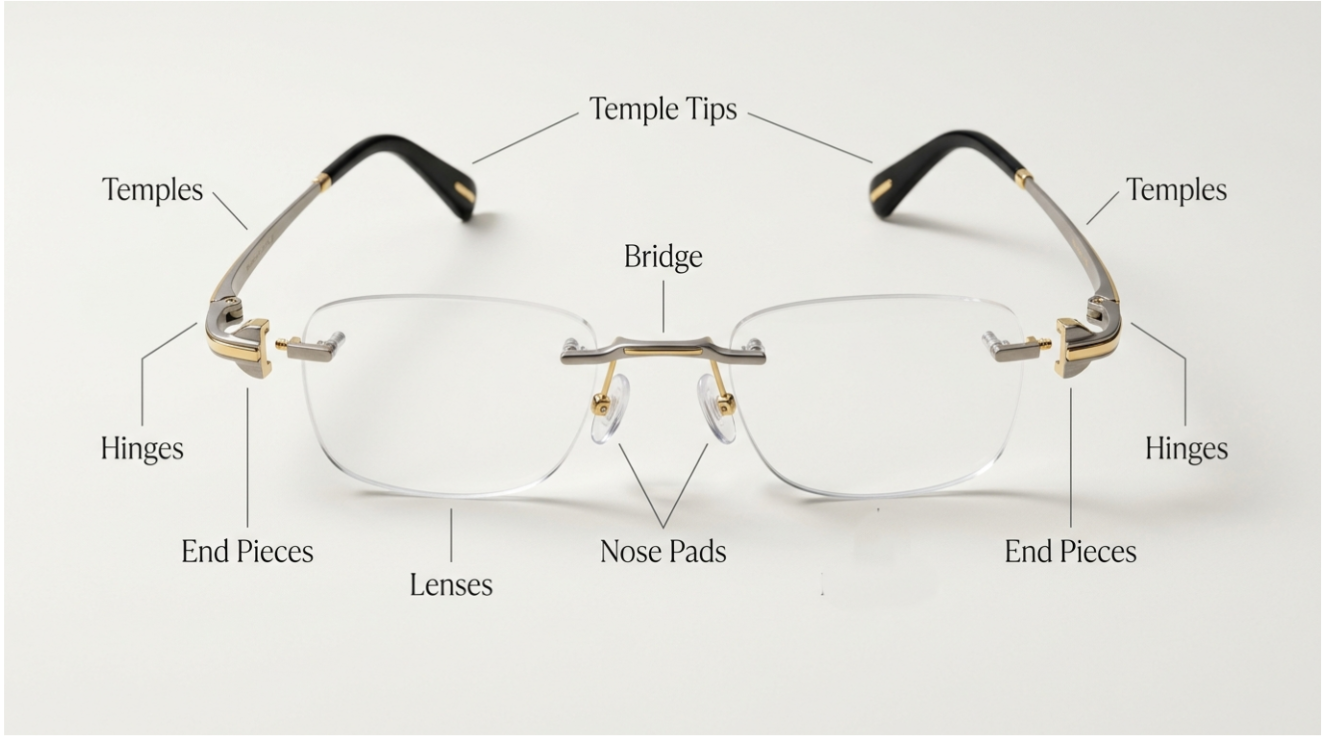
Parts of Glasses Explained: Frame, Bridge, Temple, Nose Pads and Lenses
A pair of glasses looks simple until a screw works loose. Then you notice how many small parts had to line up before the lenses ever sat in front of your eyes. The frame front holds the lenses. The...

What Are High Index Lenses and Who Needs Thinner Glasses?
Thinner lenses. The trick is the material: it bends light harder than regular plastic, so your prescription needs less of it to do the same job. Standard plastic, and a strong prescription bulges ...

Do Glasses Make Your Eyes Worse? What New Wearers Should Know
Your first pair of glasses does something odd. The world goes sharp. Suddenly there's text you can read from the couch, and a street sign you'd been guessing at for months. You wonder how you coped...

Best Lens Color for Fishing Sunglasses: Polarized Lens Guide
what color lens is best for fishing in 2026 Ask three anglers what color lens is best for fishing and you'll get four answers, a story about a lost pair of glasses, and probably a strong opinion ab...


